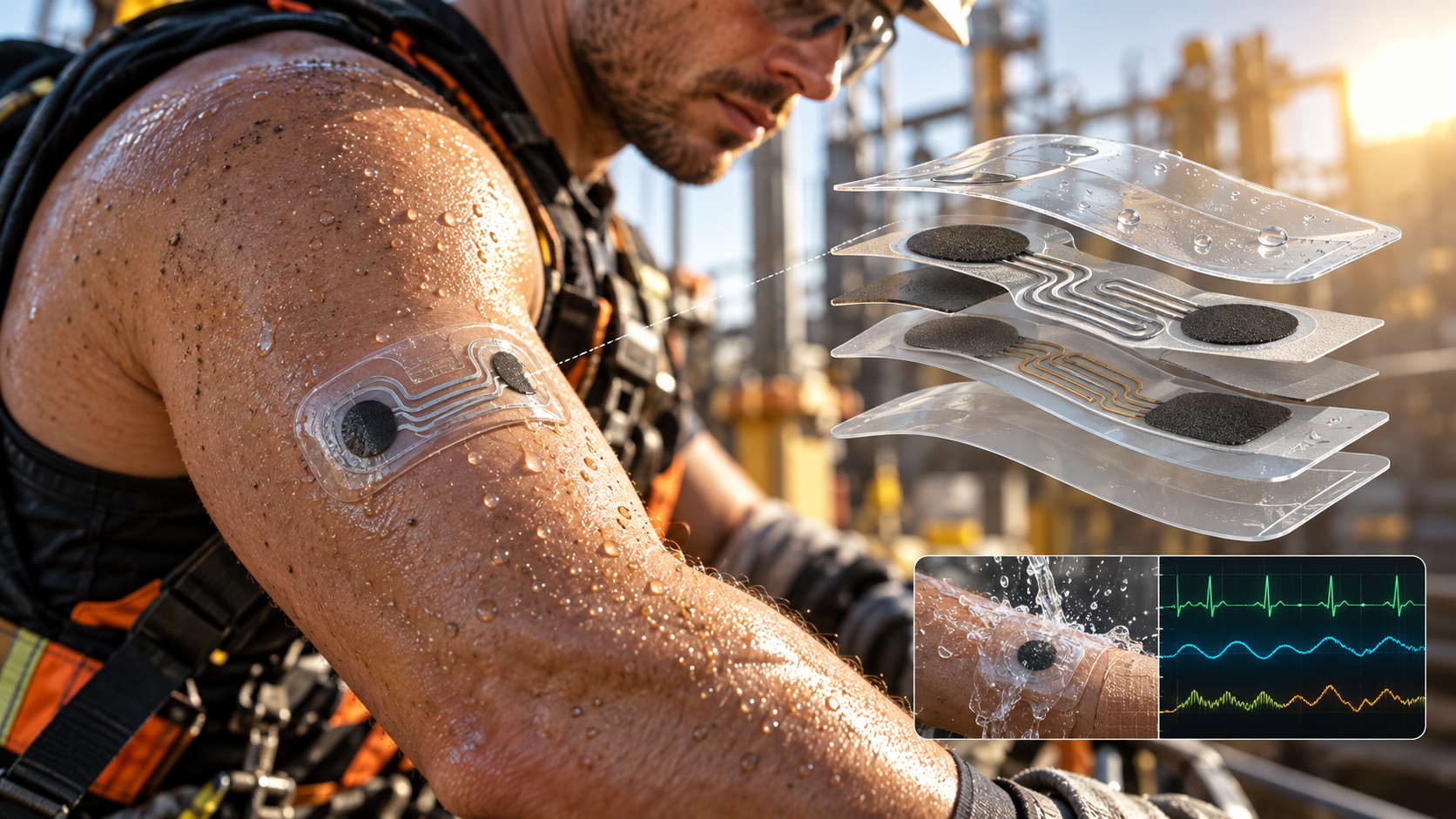
A biometric sensor that works on a bench in a climate-controlled room is not a product. The product is the one that still returns a usable signal after a shift in a hot warehouse, a wash cycle, a cold morning, or three weeks of sweat.
Harsh environment design for printed biometric sensors is not a single feature. It is a series of decisions about electrode material, substrate, encapsulation, and mechanical strain, each of which can be got wrong independently.
Quick answer: Printed biometric sensors survive harsh conditions through electrode material selection, a stretchable substrate that moves with the body, encapsulation that keeps moisture away from the conductors, and mechanical design that isolates the sensing area from strain. Carbon electrodes resist corrosion, silver silver chloride delivers the cleanest signal, and a coverlay with a carbon overprint protects both from wear.
The Electrode Decides the Signal
The electrode is the layer that actually touches the skin, so its material sets the ceiling on everything else.
- Silver silver chloride (Ag/AgCl) is non-polarized with a very low half-cell potential of about 220 millivolts, which is why it is the clinical standard for high-fidelity ECG
- Bare silver is more prone to oxidation, polarization, and skin reaction, so it is frequently paired with an Ag/AgCl or carbon top layer
- Carbon is chemically inert, corrosion resistant, and durable, though more polarizable than Ag/AgCl. In harsh environments, this trade is often worth making
- Proprietary conductive ink blends are formulated to balance conductivity, flexibility, and skin compatibility for specific applications
For harsh conditions the choice frequently comes down to a straightforward question. Does the application need clinical grade signal fidelity, or does it need to survive? Carbon leans toward survival, Ag/AgCl toward fidelity, and many designs use both in a layered construction. A fuller breakdown of electrode types in printed biometric sensors covers the classification in detail.
Wet Versus Dry, and Why It Matters Outdoors
Wet gel electrodes remain the clinical standard for high fidelity work, but the gel dries out, limits wear time, and is messy in the field.
Dry electrodes are comfortable, reusable, and mess free, and modern printed dry electrodes can achieve signal to noise ratios comparable to conventional wet electrodes. Because they are not adhesive, they rely on compression garments or tightly strapped wearables to maintain contact.
In a harsh environment that dependency becomes a design requirement rather than a detail. Contact pressure has to survive movement, sweat, and the garment being put on incorrectly.
The Substrate Has to Move With the Body
Printed biometric electrodes are commonly built by screen printing conductive inks onto thin stretchable thermoplastic polyurethane films. The reason is mechanical rather than electrical.
A rigid or minimally elastic substrate concentrates strain at the electrode edge, which is where cracking starts. A substrate that stretches with the skin distributes that strain and keeps the conductor intact through motion. Every subsequent durability decision depends on that choice being right.
Encapsulation Is Where Field Life Is Won
Moisture reaching a printed conductor is the most common cause of failure in the field, and encapsulation is the defense.
- A coverlay protects the conductor traces beneath the electrode
- A carbon overprint over the electrode adds wear resistance where the skin contact happens
- Sealed edges prevent sweat and cleaning agents from tracking in laterally
- Proper encapsulation is what makes a printed sensor washable, and it is specified rather than assumed
The layer order matters as much as the materials. The electrode sits between the conductor traces beneath it and the skin above it, and each interface is a potential ingress path.
Designing Around Motion Artifact
In harsh environments the noise source is usually not electrical. It is mechanical.
Every relative movement between electrode and skin produces a signal change indistinguishable from real physiology at the sensing stage. The fixes are mechanical and geometric rather than electronic: keep the sensing area small relative to the substrate, isolate it from the strain path, maintain even contact pressure, and place electrodes where skin moves least during the activity the device is designed for.
Organizations producing printed biometric sensors, such as Butler Technologies, Inc., design the electrode, the conductor routing, and the encapsulation as one stack for this reason, since motion performance is decided by the combination rather than by any single layer.
Also read: How Printed Biometric Sensors Capture Bioelectric Signals
Sensing and Stimulating on the Same Platform
One practical advantage of printed construction in demanding applications is that the same flexible platform can be designed to both sense and stimulate.
Recording electrodes cover ECG, EMG, and EEG. Stimulating electrodes cover EMS for muscle recovery, TENS for drug free pain relief, and NMES for rehabilitation. A single device can therefore monitor and treat, which reduces the number of separate items that have to survive the environment.
Also read: Types of Biometric Signals Printed Sensors Can Measure
Key Takeaways
- Electrode material sets the trade between signal fidelity and survivability, with Ag/AgCl at 220 millivolts for fidelity and carbon for corrosion resistance
- A stretchable TPU substrate distributes strain that would otherwise crack the conductor at the electrode edge
- Encapsulation, not the electrode, is usually what determines field life
- Motion artifact is a mechanical problem solved through geometry and contact pressure, not through filtering
FAQs
What makes a printed biometric sensor fail in the field?
Most commonly moisture reaching the printed conductor, and mechanical cracking where strain concentrates at the electrode edge. Both are addressed through encapsulation and through a substrate that stretches with the skin rather than resisting it.
Which electrode material is best for harsh conditions?
Carbon is chemically inert and corrosion resistant, making it well suited to demanding environments, though it is more polarizable than silver silver chloride. Many designs use a layered construction to get both durability and signal quality.
Can printed biometric sensors be washed?
With proper encapsulation, yes. Washability is a function of the sealing and coverlay construction rather than of the electrode itself, and it has to be specified rather than assumed.
Do dry electrodes perform as well as wet gel electrodes?
Modern printed dry electrodes can achieve signal to noise ratios comparable to conventional wet electrodes. Because they are not adhesive, they depend on compression garments or straps to maintain contact, which becomes a design requirement in active or harsh environments.