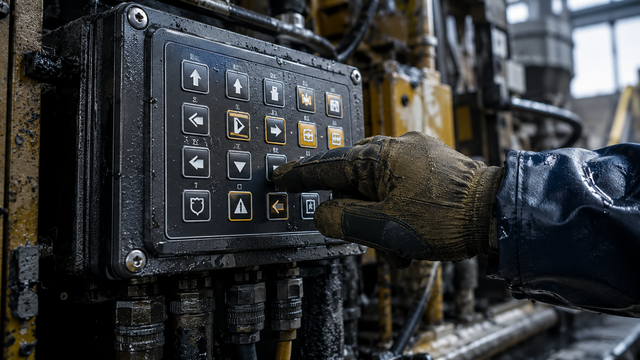
On a factory floor, a keypad is not a convenience. It is the control point for the machine. And the factory floor is unforgiving: dust, washdown, oil, solvents, vibration, temperature swings, and gloved hands are the rule, not the exception.
A keypad designed for an office will not last a month in these conditions. An industrial keypad is engineered to survive for years. The difference comes down to how the interface is built, which is why most rugged designs are built on sealed membrane switch construction rather than the capacitive capacitive touch panels common in consumer devices. Here is how a harsh-environment keypad is actually designed.
Quick answer: Designing an industrial keypad for harsh environments means using sealed, multi-layer construction, chemical- and UV-resistant materials, a defined ingress-protection rating (IP65 or higher), and tactile feedback that works with gloves, so the keypad survives dust, water, chemicals, and heavy use. Ingress protection is defined by the international IP Code (IEC 60529); IP65, meaning dust-tight and protected from low-pressure water jets, is the common baseline for industrial equipment, and quality membrane keypads are rated for 1 to 5 million actuations.
What Counts as a Harsh Environment
Before choosing materials, define the actual conditions the keypad will face. Common stressors include:
- Dust, dirt, and airborne contaminants
- Water, moisture, condensation, and high-pressure washdown
- Chemicals, cleaning agents, oils, and solvents
- Wide temperature ranges and thermal shock
- Vibration, impact, and abrasion
- Frequent use by operators wearing gloves or PPE
Most industrial settings combine several of these at once, so the design has to respect all of them, not just the most obvious one.
Sealing and Ingress Protection
Sealing is what keeps the inside of the keypad intact. The goal is a defined IP rating, IP65 as a common baseline, with higher ratings for outdoor or washdown use. Effective sealing depends on:
- Sealed edges and gaskets around the perimeter
- Fully welded or laminated construction with no exposed openings
- Sealed connector tails and cable entries, a common and often overlooked failure point
A membrane switch construction is well suited to harsh environments because it is a sealed, flat, multi-layer assembly with no gaps for contaminants to enter. Understanding how those layers work together is central to getting the sealing right; our breakdown of the anatomy of a membrane switch and its six critical layers explains how overlays, spacers, circuits, and adhesives combine into a reliable, sealed HMI.
Material Selection
The overlay is the first line of defense against the environment, so material choice is where harsh-environment design begins.
- Polyester (PET) for high chemical and abrasion resistance and long flex life
- Polycarbonate (PC) where embossing and optical clarity matter more
- Hard coats and textured finishes to resist scratching, chemicals, and fingerprints
- Adhesives rated for the temperatures and chemicals the keypad will actually see
The overlay also carries the printed graphic overlay that operators read and interact with, so the material has to protect the graphics as well as the circuit beneath them.
Tactile Feedback That Survives Gloves
Operators wearing gloves need to feel the press, not just see it. Tactile feedback is engineered into the assembly through:
- Metal snap domes for a sharp, high-force click that carries through gloves
- Polydomes for a softer feel and better moisture resistance
- Emboss geometry tuned so keys are easy to locate by touch alone
In fast-paced or safety-critical settings, this physical confirmation reduces operator error and improves confidence in a way that visual or audio feedback cannot match.
Backlighting and Legibility in the Field
A keypad has to be readable in direct sunlight and at night, so legibility is a design requirement, not an afterthought.
- LED or fiber-optic backlighting for low-light visibility
- High-contrast graphics and legends that survive UV exposure
- Anti-glare finishes to keep values readable in bright light
Durability and Cycle Life
Industrial keypads are rated for millions of actuations. Achieving that means controlling dome fatigue, adhesive creep, and abrasion of the printed graphics over the full service life, not just at first article. A keypad that passes inspection on day one but degrades after six months in the field has not actually met the requirement.
Where Manufacturing Precision Becomes Critical
An industrial keypad only performs consistently if it is made consistently. Print quality, lamination, sealing, and material control decide whether it survives the field or fails early.
Organizations working in printed electronics, membrane switches and keypads, and related interface components, such as Butler Technologies, Inc., build these products on controlled, in-house production lines so performance stays consistent from the first unit to the ten-thousandth. That repeatability is what turns a good design on paper into a keypad that delivers millions of reliable actuations in the real world.
The Real Goal of Harsh-Environment Keypad Design
A well-designed industrial keypad disappears into the machine and simply works, shift after shift, in conditions that would destroy a consumer-grade part. That reliability is designed in from the first material choice, not added at the end.
Key Takeaways
- Define the real environment, dust, water, chemicals, temperature, and glove use, before choosing materials
- Target a defined IP rating (IP65 baseline) with sealed edges and sealed connector tails
- Use PET or PC overlays with hard coats for chemical, UV, and abrasion resistance
- Match dome technology (metal vs poly) to glove use, feel, and cycle life
- Consistent, in-house manufacturing is what delivers millions of reliable actuations
FAQs
What makes a keypad suitable for harsh environments?
A harsh-environment keypad uses sealed, multi-layer construction, chemical- and UV-resistant materials, a defined IP rating, and tactile feedback that works with gloves, so it can survive dust, water, chemicals, temperature, and heavy use.
What IP rating do industrial keypads need?
IP65 is a common baseline for industrial use, meaning dust-tight and protected from low-pressure water jets. Outdoor, wet, or washdown applications often require IP66, IP67, or higher.
Are membrane switches good for harsh environments?
Yes. Membrane switches are sealed, flat, multi-layer assemblies with no gaps for contaminants, which makes them a strong choice for dusty, wet, and chemically exposed environments.
How do you design a keypad for gloved use?
Use higher-force tactile feedback such as metal domes, clear emboss geometry so keys can be located by touch, and generous key spacing so gloved fingers can operate the keypad accurately.